


The success of the Artemis II mission marks more than a breakthrough in human space exploration.
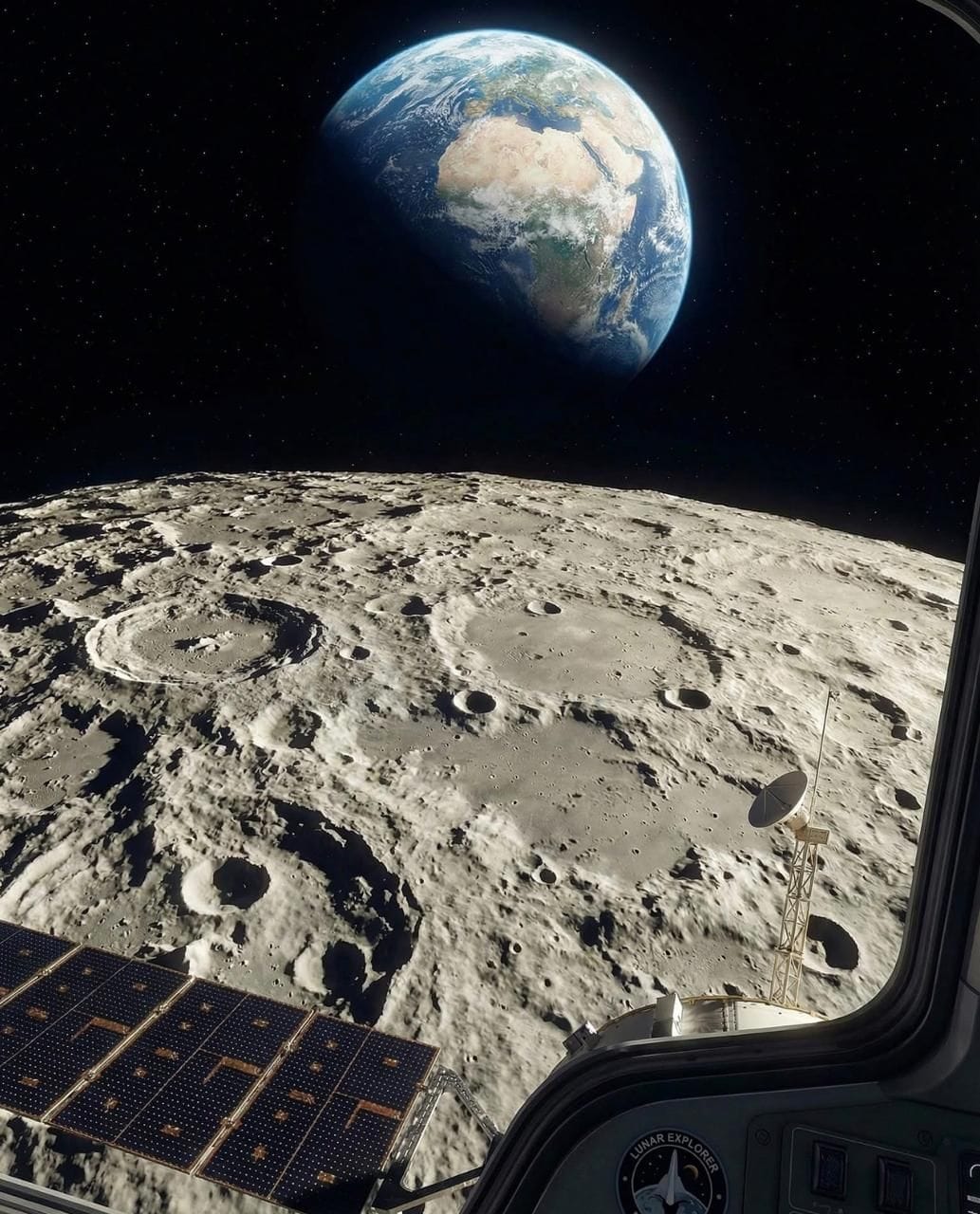
With the spacecraft completing its historic lunar observation phase, surpassing previous distance records from Earth, and transmitting unprecedented data from the far side of the Moon, we are witnessing a shift in the role space plays in the global economy.
Orion’s journey back home is not just a return trajectory it is a signal that space is rapidly transitioning from exploration to infrastructure.
For Africa, and particularly Kenya, these milestones are not distant scientific achievements.
They represent a turning point in how the continent positions itself within the next industrial frontier.

Space as Infrastructure, Not Symbolism
Space used to be framed as a domain of discovery and national prestige.
That framing is becoming obsolete. Today, space systems function as core infrastructure layers that support communications, navigation, climate intelligence, logistics, and security systems across the world.
Modern spaceports, in this context, are not launch sites alone.
They are integrated systems that connect data, energy, manufacturing, and global trade flows.
They sit at the intersection of multiple industries and increasingly behave like industrial ecosystems rather than standalone facilities.
It is within this shift that the idea of a commercial spaceport in Lamu gains strategic meaning.
It is not about replicating global space programs, but about embedding East Africa into a converging system of maritime, digital, and orbital infrastructure.
This vision aligns naturally with the broader development logic of the LAPSSET Corridor, Kenya, which already positions Kenya as a critical gateway between the Indian Ocean and the African interior.
A space-enabled extension of this corridor would add a new dimension: orbital connectivity.
The Convergence of Space, Data, and Trade
The most important output of the modern space economy is not rockets it is data.
Satellites continuously generate vast streams of information that must be processed, analyzed, and translated into economic value in real time.
This is where space infrastructure becomes inseparable from cloud computing and artificial intelligence.
Future space systems depend on distributed computing architectures that combine cloud platforms with edge processing capabilities.
This allows satellite data to be transformed immediately into usable insights rather than stored and analyzed retrospectively.
The implications are far-reaching. Agricultural systems can be monitored at scale, maritime activity can be tracked with precision, and climate risks can be forecast with far greater accuracy than traditional systems allow.
In this sense, space is no longer separate from terrestrial economies. It is becoming the intelligence layer that sits above them.
Beyond Data: The Industrial Frontiers of Space
The space economy is also opening new frontiers in science and industrial production.
Microgravity research is accelerating breakthroughs in biotechnology, particularly in drug development and molecular science.
Conditions in orbit allow researchers to test processes that are impossible on Earth, creating pathways for entirely new categories of medical innovation.
At the same time, satellite-enabled logistics systems are reshaping global trade.
Supply chains are becoming more efficient as real-time tracking, predictive routing, and automated monitoring reduce delays and improve coordination across ports and transport corridors.
When integrated into large infrastructure systems, these technologies fundamentally change how goods move across regions.
For a country like Kenya, already positioned along major maritime routes, this creates a powerful opportunity to link physical trade infrastructure with space-enabled intelligence systems.
Building an African Space Capability Ecosystem
Within this evolving landscape, AfriTrade Consulting Group has been developing a structured approach to positioning Africa within the emerging space economy.
The focus is not simply participation, but capability building ensuring that infrastructure, expertise, and capital are aligned in ways that allow African economies to move up the value chain.
This approach is being advanced through a joint venture model that brings together European aerospace expertise, cloud infrastructure providers, and financial structuring specialists capable of managing large-scale, complex projects.
The intention is to bridge global capability with local infrastructure needs in a way that is both technically robust and economically sustainable.
Kenya’s Strategic Opportunity
Kenya occupies a uniquely advantageous position in this transition. Its equatorial geography, expanding digital economy, and access to the Indian Ocean already make it a strong candidate for integrated infrastructure development.
When combined with regional logistics frameworks and digital transformation agendas, it becomes possible to imagine Kenya not just as a participant in global systems, but as a node that actively produces space-enabled services.
A future commercial spaceport in Lamu would therefore not exist in isolation.
It would function as part of a broader ecosystem linking maritime trade, digital infrastructure, and orbital systems into a unified economic platform.
A Shift in Economic Geography
The Artemis II mission is a reminder that humanity’s operational boundary is expanding.
Space is no longer a distant frontier; it is becoming part of the infrastructure that powers life on Earth.
For Africa, this shift is defining. The choice is not whether to engage with the space economy, but how.
Engagement as a consumer will reinforce dependency. Engagement as a builder will create long-term structural relevance.
Kenya’s opportunity lies in positioning itself within this emerging convergence of data, trade, and orbital infrastructure.
The architecture of that future is still being built, and the decisions made now will determine who shapes it.
The sky is no longer a limit. It is becoming part of the system.

