
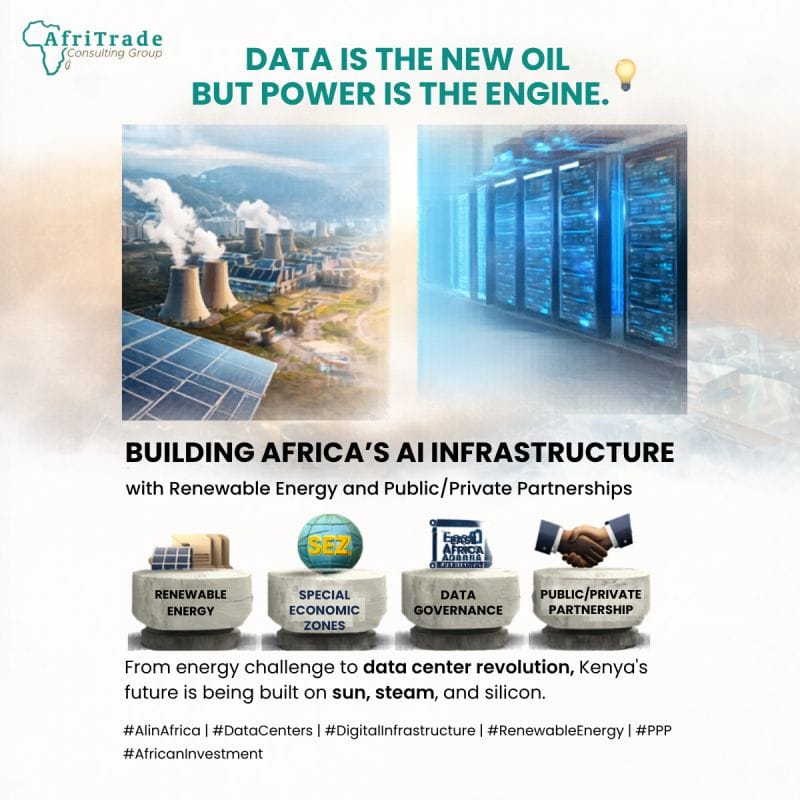

Artificial intelligence is often framed as a software revolution. In reality, it is an infrastructure problem disguised as a digital one.
Data may be the “new oil,” but without reliable, affordable energy, there is no refinery. No compute, no AI economy.
Across much of Africa, the limiting factor in scaling AI and high-performance computing is not talent or demand. It is the cost and stability of power.
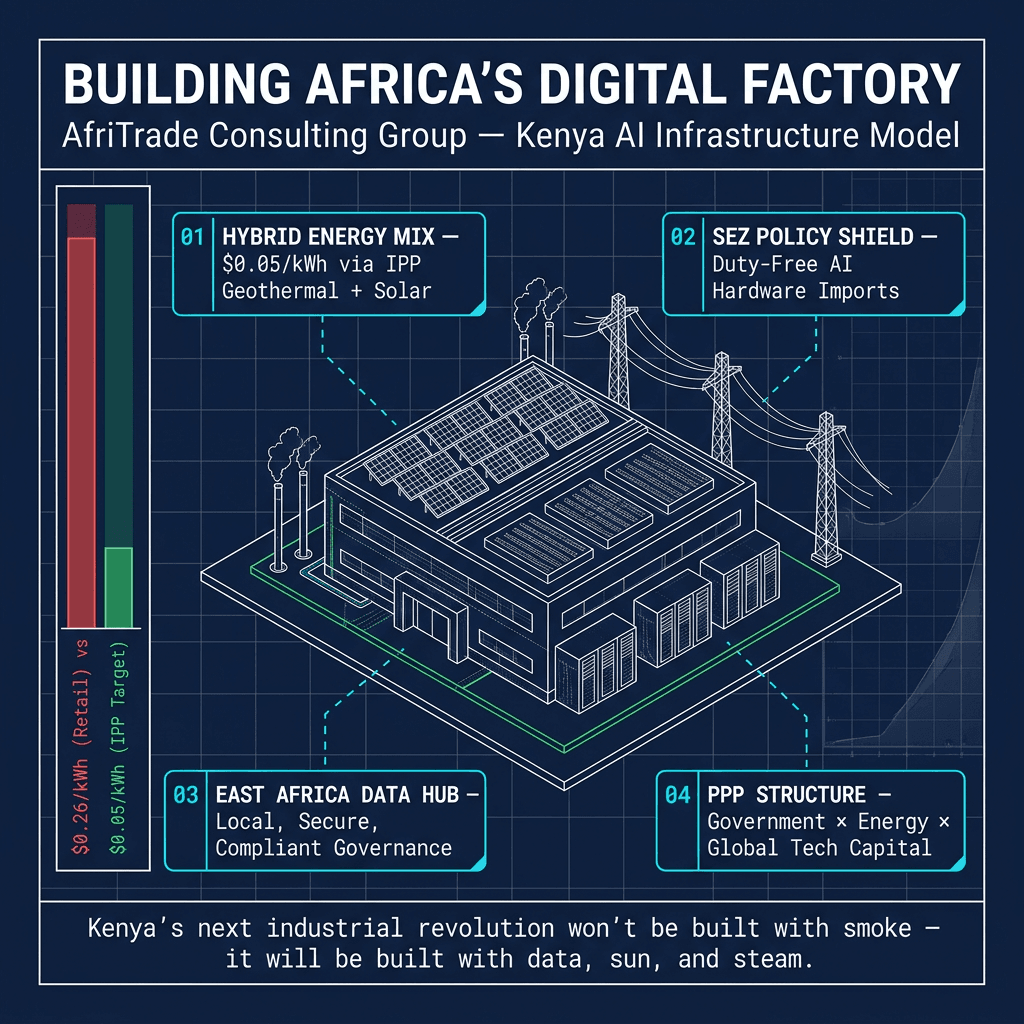
At an average of $0.26/kWh, running AI-grade data infrastructure becomes economically restrictive.
At $0.05/kWh, it becomes industrially viable. That gap is not marginal—it determines whether Africa participates in the AI economy as a producer or remains a consumer.
The Real Bottleneck in Africa’s AI Ambition
The global AI stack depends on three tightly coupled inputs:
- Compute (GPUs, servers, data centers)
- Connectivity (low-latency, high-throughput networks)
- Power (stable, low-cost, scalable energy)
Africa has made progress in connectivity and is rapidly growing its digital talent base.
However, energy economics remain misaligned with the requirements of modern compute infrastructure.
The result is a structural paradox: Regions with abundant renewable potential often have some of the highest effective costs for industrial-grade electricity.
Reframing Data Centers as “Digital Factories”
Modern AI infrastructure should be understood less as IT assets and more as industrial production systems—digital factories that convert energy into intelligence.
The economics of these factories are straightforward:
- Lower energy cost → lower cost per compute cycle
- Higher uptime stability → higher model reliability
- Local energy generation → reduced latency and dependency risk
This is where infrastructure design becomes a strategic lever, not just an engineering decision.
A Model for Competitive AI Infrastructure in Africa
At AfriTrade Consulting Group, a development model has been structured to address the core constraints holding back scalable AI infrastructure in the region.
The approach focuses on aligning energy systems, regulatory frameworks, and investment structures into a unified delivery model.
1. Hybrid Energy Mix (Cost + Uptime Optimization)
Instead of relying on high-cost retail electricity tariffs, the model prioritizes direct integration with Independent Power Producers (IPPs).
Kenya’s geothermal and solar capacity provide a strong base for:
- Stable baseload geothermal generation
- Scalable solar deployment for peak balancing
- Grid offset strategies to reduce marginal cost per kWh
The objective is to approach a ~$0.05/kWh operational threshold, while maintaining high uptime through redundancy design.
2. Strategic Use of Special Economic Zones (SEZs)
Infrastructure scale requires regulatory efficiency.
By locating AI and data infrastructure within Special Economic Zones, it becomes possible to:
- Reduce import friction on GPUs and high-performance servers
- Access tax incentives for capital-intensive infrastructure
- Streamline permitting and construction timelines
This is not a tax arbitrage strategy—it is an industrial acceleration mechanism.
3. Regional Data Governance and Localization
Data sovereignty is becoming a defining issue in global AI deployment.
Using the East African data governance frameworks, the model ensures:
- Local data residency compliance
- Secure cross-border data handling where applicable
- Alignment with emerging regional digital regulations
This positions infrastructure not just as compute capacity, but as trusted regional digital infrastructure.
4. Public–Private Partnership Structuring
No single stakeholder can finance or operationalize AI-scale infrastructure alone.
A structured Public–Private Partnership (PPP) approach is central to de-risking deployment:
- Governments provide policy stability and enabling frameworks
- Private energy producers deliver scalable generation capacity
- Global and regional investors provide capital and technical expertise
This triangulation reduces capital risk, accelerates approvals, and ensures long-term operational continuity.
Kenya as an Emerging AI Infrastructure Node
Kenya is uniquely positioned within this transition due to:
- Significant geothermal capacity in the Rift Valley
- Rapid solar expansion potential
- An increasingly sophisticated digital services ecosystem
- Regional connectivity to East and Central Africa markets
This combination makes it a viable candidate for AI infrastructure localization—provided energy pricing and regulatory efficiency align with industrial requirements.
The Strategic Shift: From Consumption to Production
The global AI economy is consolidating around a small number of compute hubs.
The question for Africa is not whether it can participate, but how.
If energy remains expensive and fragmented, Africa will continue importing intelligence infrastructure.
If energy is made scalable, affordable, and stable, the continent can transition into a producer of compute not just a consumer of AI services.
This is the inflection point.
Building the Engine
AI will not be won on algorithms alone. It will be won on infrastructure economics.
Africa’s constraint is not imaginationit is industrial readiness. And that readiness begins with energy.
The future digital economy will be built where data, power, and capital converge efficiently. In East Africa, that convergence is already technically possible.
The remaining challenge is coordination.
Kenya’s next industrial leap will not be defined by smokestacks but by data centers powered by sun, steam, and structured investment.
And the opportunity is still open to build it right.

