
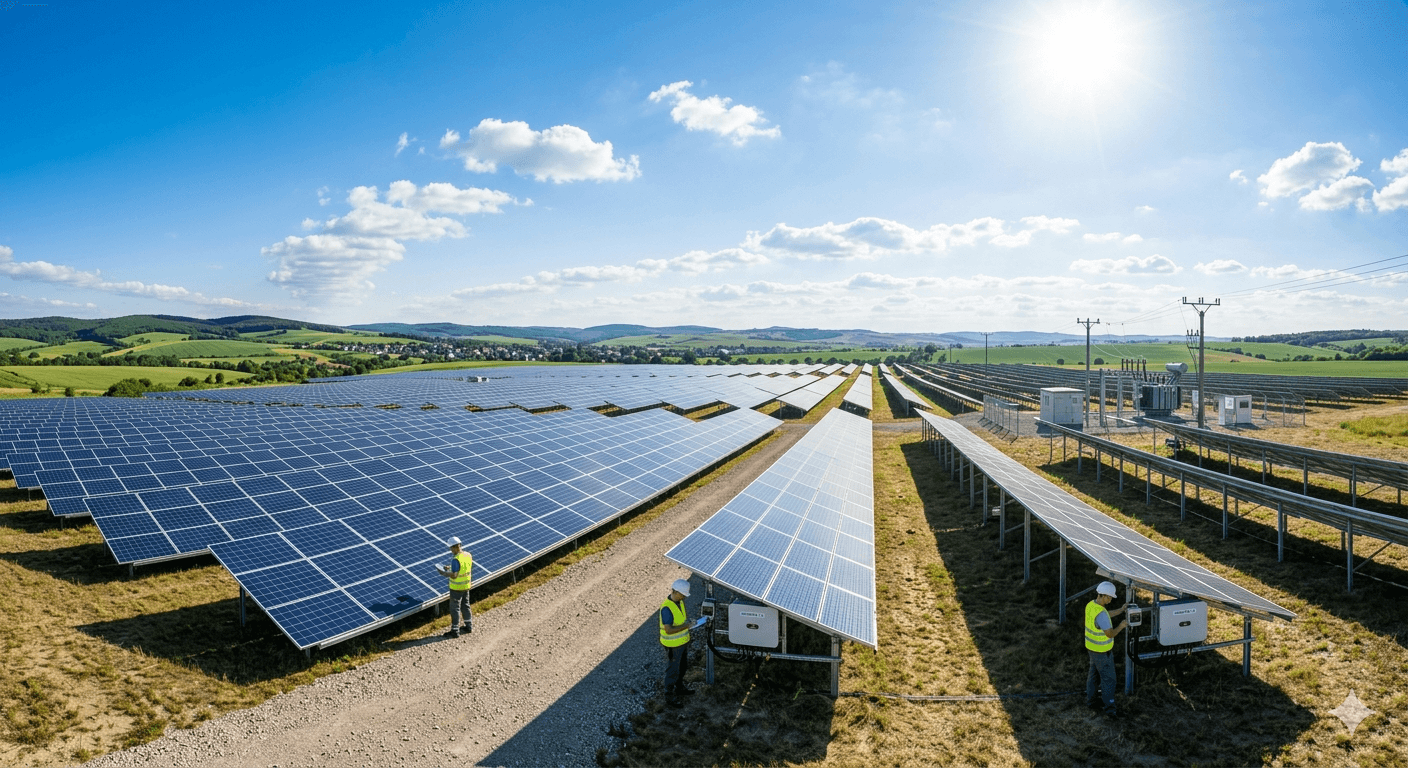

Energy Is No Longer Just a Utility
For decades, energy was treated as a fixed operational cost in manufacturing unpredictable, unavoidable, and largely outside a company’s control.
Today, that reality is changing rapidly.
Across Africa, manufacturers are increasingly turning to commercial and industrial (C&I) solar solutions not just to reduce costs, but to secure competitiveness in a demanding and fast-changing market.
From textile manufacturers to industrial parks and export-driven factories, the migration toward solar is accelerating.
As businesses seek protection from rising electricity tariffs, grid instability, and growing sustainability requirements within global supply chains.
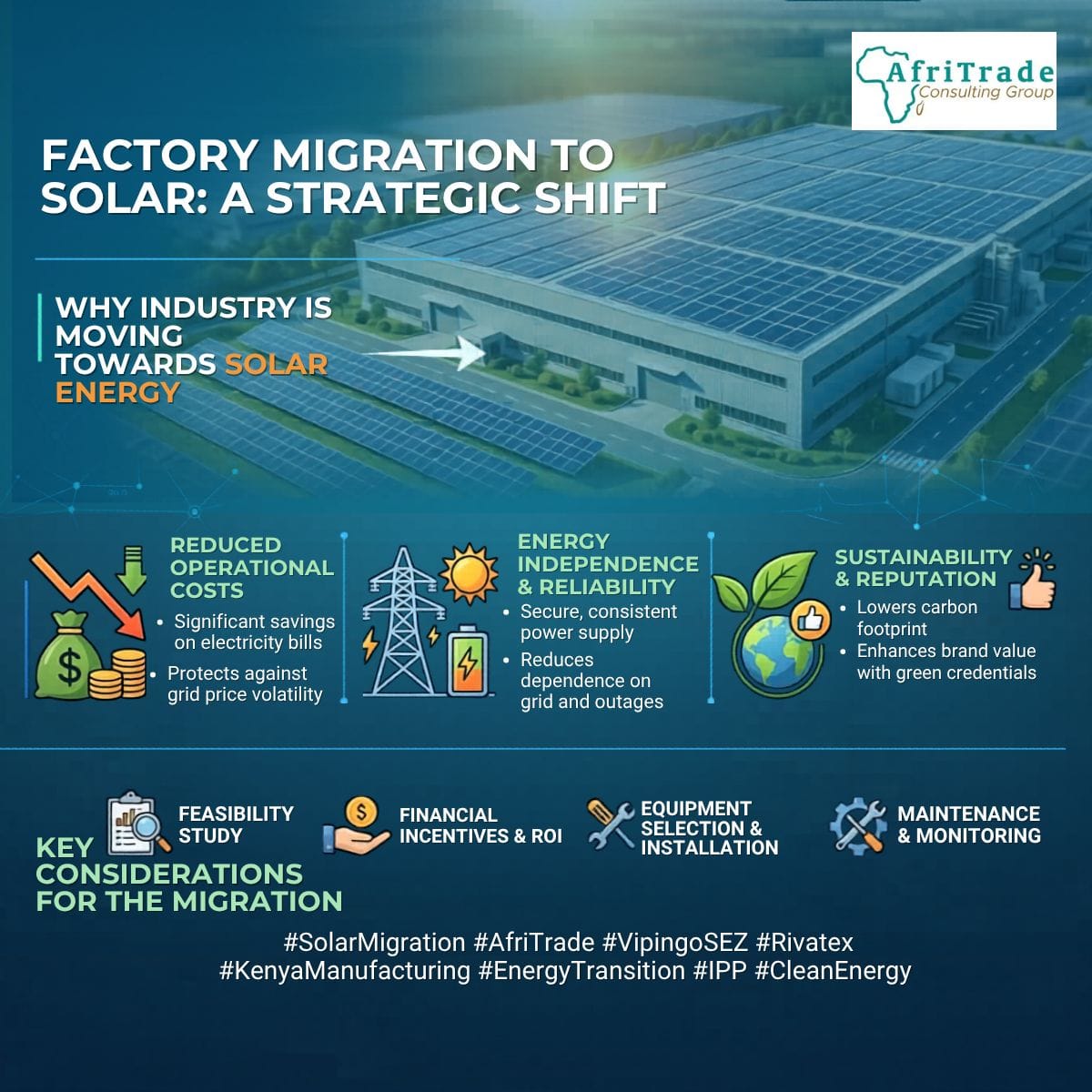
At AfriTrade Consulting Group, we are seeing firsthand how renewable energy is reshaping industrial growth across the region.
Modern manufacturing is becoming more energy-intensive at a time when electricity prices continue to rise, and production efficiency is under constant pressure.
For many factories, energy disruptions now directly affect productivity, operational costs, and supply chain reliability.
As a result, industrial players are no longer viewing power simply as infrastructure. Energy has become a strategic business decision and, increasingly, a competitive advantage.
Kenya’s Shift Toward Industrial Solar
Commercial and industrial solar is emerging as one of the most effective solutions because it addresses several challenges simultaneously.
Businesses gain lower and more predictable energy costs, reduced reliance on unstable grids, improved sustainability performance, and stronger positioning within international supply chains where buyers are placing growing pressure on suppliers to demonstrate greener production systems.
Kenya is already beginning to witness this transition at scale.
One of the clearest examples is the 32 MW solar PV project structured within the Vipingo Special Economic Zone.
Where AfriTrade Consulting Group played a key role in supporting the development of a large-scale renewable energy solution designed to supply manufacturers with stable, affordable, and green power.
The project reflects a broader shift taking place across industrial zones and manufacturing hubs as companies seek long-term energy certainty in an environment where power costs increasingly determine competitiveness.
The Rivatex Model
The transition is also transforming individual manufacturers.
At Rivatex East Africa Limited, AfriTrade structured a rooftop Independent Power Producer (IPP) arrangement projected to reduce the company’s energy costs by approximately 40 percent once operational.
The significance of the Rivatex project extends beyond energy savings.
Alongside the rooftop solar initiative, AfriTrade Consulting Group also led the National Cotton, Textile and Apparel (CTA) Policy process, helping shape the broader framework needed to support industrial expansion within Kenya’s textile value chain.
Together, these efforts highlight how energy, industrial policy, and manufacturing competitiveness are becoming increasingly interconnected.
Why Manufacturers Are Making the Move
One of the biggest reasons manufacturers are shifting toward solar is the evolution of financing models.
Traditionally, renewable energy projects required heavy upfront capital investment, making adoption difficult for many businesses.
Today, structures such as IPP models are changing that equation by allowing manufacturers to access solar power without bearing the upfront cost of developing and operating the infrastructure themselves.
This creates immediate advantages through lower operational costs, improved energy predictability, and reduced exposure to tariff volatility, all while easing pressure on capital expenditure budgets. For manufacturers operating on tight margins, these efficiencies can directly influence profitability and long-term scalability.
The transition is also being driven by growing pressure from international buyers and investors who increasingly expect manufacturers to align with sustainability and clean energy standards.
The Future of Industrial Growth
The conversation around industrial solar is no longer about whether the transition will happen. It is already happening.
Across Africa, manufacturers are increasingly recognizing that energy strategy is inseparable from growth strategy.
Businesses that secure stable, affordable, and sustainable power are positioning themselves to compete more effectively in both regional and international markets.
At the same time, governments and development partners are placing greater emphasis on green industrialisation, sustainable infrastructure, and clean energy integration within manufacturing ecosystems.
Companies that delay adaptation risk higher production costs, slower expansion, and reduced competitiveness in markets rapidly evolving toward cleaner and more efficient production systems.
At AfriTrade Consulting Group, we believe Africa’s industrial future will be shaped by the intersection of energy, policy, investment, and infrastructure.
Our work across industrial energy projects, trade policy, and manufacturing ecosystems reflects a broader commitment to helping businesses unlock scalable and sustainable growth opportunities.
Because increasingly, the future of manufacturing will belong to companies that can produce more efficiently, more sustainably, and more competitively.
And that future is being powered by solar.

